Being Judgemental Again

Badge awarded to judges at the 2010 World Cheese Awards

I’ve confirmed that I’ll be judging at the World Cheese Awards again this year, on 28th November at the BBC Good Food Show at the NEC. For 2012 there are almost 3,000 cheeses from 300 countries. If you want to come and watch tickets can be had from the BBC – there’s all sorts going on and proper foodie slebs like James Martin and Paul Hollywood as well, not just cheesy old farts like me. This will be my third outing, you can read about the first one here.

Christmas Pudding Time Again

It’s time to dust off the Christmas pudding recipe again – this first appeared in 2010 when I did miss the ‘official day’ for pudding making. I’m soaking fruit now for a pudding steaming session this weekend which includes 2012′s ‘stir up Sunday’…

Mixed fruits soaking for a Christmas pudding

Last Sunday was apparently ‘stir up Sunday’, the last Sunday before Advent when traditionally we’d begin preparing puddings for Christmas. However the Shopkeeper and I had been entertaining until the early hours and when I caught sight of myself in the bathroom mirror that morning the idea of taking some wrinkled old fruits and soaking them in booze was just a touch too ironic to contemplate.

Not to worry, there is still time to prepare your puddings. It’s really not difficult, and so much more satisfying than opening a shop bought box on Christmas day. I base mine on a recipe I first picked up in Waitrose nearly ten years ago but I’ve tinkered with and tweaked it over the years. Unlike the precise science of cake baking, puddings are very forgiving of changes so you don’t need to agonise or work with milligram precision. Last year I realised two hours into the steaming time that I’d forgotten the flour altogether, and the puddings were none the worse for it. My main changes have been to reduce the amount of sugar and flour, and to up the fruit and booze content – I really can’t imagine making a Christmas pudding with only two tablespoons of brandy! I also try to find an interesting mix of fruits to add to the basic raisins and sultanas. For instance this year we have some ‘Persian Delights’ dried fruit mixes in the shop which include pineapple, papaya and mango, so a packet of these has joined the other fruits in their brandy, orange juice and spice bath. And I have to have halved glacé cherries! They were always there in my childhood Christmas puddings, feel free to add any childhood memories of your own.

These quantities will make two 1.5 litre puddings, each big enough for eight people with some to spare [no harm in having a spare, and they make great gifts]. If you only want one, halve these quantities but the cooking time will be the same. You can also make small individual puddings which will take just two hours to steam.

  • 1.2 kg dried fruits, including 350 g each of raisins and sultanas, the rest made up of a mixture of whatever takes your fancy from cranberries, apricots, cherries [dried or glacé], blueberries, candied peel, etc. The more the merrier!
  • 500 ml stout
  • 200 ml brandy
  • 1 tbsp toffee vodka [optional]
  • Finely grated zest and juice of 2 oranges
  • 1 tsp freshly grated nutmeg
  • 2 tsp ground cinnamon
  • 2 tsp mixed spice
  • 250 g suet [vegetable suet can be used if vegetarian]
  • 100 g flour
  • 200 g breadcrumbs
  • 100 g muscovado sugar
  • 1 tbsp golden syrup
  • 1 large apple [Bramley for preference] peeled and grated
  • 4 large eggs, beaten
  • 1 silver coin, any currency or denomination!

Start by mixing the dried fruits with the orange juice and zest, spices, stout and brandy [and toffee vodka if using]. Leave to soak for a couple of days, stirring from time to time. Mine is doing this now [on top of the washing machine to make best use of the vibrations] and every stir fills the kitchen with the smell of Christmas.

When I’m ready to cook this tomorrow I’ll add all the other ingredients and mix well. Traditionally everyone in the house should stir the mix whilst making a wish, and I might even invite a few of the neighbours to have a go just to make sure. Grease the pudding basins [1.5 litre capacity] and fill them to a couple of centimetres below the rim, tapping and pushing down well to make sure there are no gaps or air bubbles.

The only really fiddly bit is sealing the basins for steaming, and if you really can’t be bothered then you can buy plastic versions with clip on lids. Otherwise for each basin cut two large squares of greaseproof paper and one of foil and stack them with the foil on top. Fold once near the middle, and then back again about two centimetres away to make a pleat. Cover the top of the basin with your pleated sheets and tie around with string. It will help if you can loop through another piece of string to make a handle, but this is easier with four hands so enrol a helper. You let your neighbour make a wish didn’t you? Well it’s payback time.
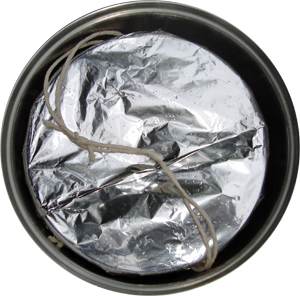
A wrapped Christmas Pudding ready for steaming

Place each sealed basin onto a trivet [an upturned heat-proof plate will do] in a pan and carefully pour in boiling water to around half way up the basin’s sides. Cover the pan, and once simmering steam the puddings for six hours. Check the water from time to time and top up as necessary. Six whole hours when you can’t leave them entirely alone but they will require little of your attention – time to do some online Christmas shopping perhaps, or to write your cards?

Once they’re done allow the puddings to cool, remove the foil etc., wipe the bowls clean and decide whether you plan to reheat them by steaming again or in the microwave. If the former then repeat the wrapping process described above. If you’re microwaving then simply cover well with two or three layers of clingfilm. Place the puddings somewhere cool and dark [I wrap them in plastic bags too] and forget about them until Christmas morning.

Come the big day heat your pudding by steaming for two hours, or give it six minutes on full power in an 850 watt microwave. Wrap your silver coin in foil [easier to find, less easy to swallow by accident, and cleaner] and make a slit in the base of the pudding to insert it. Ease the pudding from its bowl onto a plate, warm a ladleful of brandy, pour over and set alight. I can never resist a sprig of holly too.

You might want custard or cream, but I must have brandy butter with this. Recipe to follow when I make it a week or so before Christmas…

Baked Figs

Figs ready for baking, with ginger wine, honey and rosemary.

It’s fair to say I wasn’t expecting a heart attack. Frankly Monty Python had more of an inkling about the Spanish Inquisition, and we all know how expected that was. Yes, I had the genetic predisposition and lived the lifestyle – but ticking all the boxes doesn’t always win you the main prize. Not always…

This time though I knew I must have hit some kind of jackpot because blue lights started flashing, sirens wailed and the machine wired up to my chest made frequent, frantic beeping noises. Turns out this prize was life-saving, piercing-edge, percutaneous surgery, and the specialist teams at the West Middlesex and Hammersmith Hospitals have earned – in every sense – my undying gratitude.

So now I’m faced with a choice food-wise: renounce totally anything enjoyable but potentially naughty and live out my days in the epicurean equivalent of a hair shirt, or expend some additional effort on finding foods that are both healthy and beautiful [whilst admitting the odd something sinful from time to time]. Actually you make the same choice several times every day, this sort of thing just has a way of turning decisions into DECISIONS.

Well I’ve made mine. And I will not go hungry into that good night.

I served this with a splodge of low fat crème fraîche, which would actually have been my choice before all the cardiac kerfuffle.

Feeds three or four

  • 12 ripe medium-sized figs
  • 100ml ginger wine
  • 1/2 tsp mixed spice
  • 1/2 tsp vanilla paste
  • a good drizzle of honey, about a tablespoon and a half [vegans can replace with a sprinkling of brown sugar]
  • a few small sprigs of rosemary
  • crème fraîche to serve [optional]

Slash the figs with deep, quartering cuts almost all the way through, and arrange snugly in a shallow dish. Whisk the spice and vanilla into the ginger wine and pour over the figs. Drizzle the honey over and into the figs, strew the rosemary sprigs about, and bake in a 190C oven for 25 minutes to half an hour. Baste with the juices once or twice during cooking, and spoon over plenty as you serve.

Glitch Fixed

If you’ve tried to share any posts using the ‘Reddit’ share button recently you may have experienced a problem. The good people at WordPress have fixed this now so feel free to click away and share via Reddit, or any of the other sharing options available at the bottom of each post. Options include Facebook, Twitter, StumbleUpon, Pinterest, LinkdIn, Google+, Digg, Reddit and more. Happy sharing…!

Chiken Liver Paté

Paté’s proving popular, so let’s have another…

Chicken Liver Pate topped with clarified butter, bay leaves and halved cherries.

We were entertaining the Anthropologist for a birthday lunch and with a guest who takes such care over her own entertaining a degree of effort is essential, such as making a new dish, or sacrificing several days and your sanity to prepare a little something from Heston Blumenthal [or, as on this occasion, both!]. And whilst there’s nothing new about chicken liver paté per se, I’d never done it before, so for me it counted.

I think I’d always imagined it would be a complicated business, but it turned out to be a surprisingly simple affair [unlike what was to follow!]. You can make it with just some sautéed livers, a splash of booze and some melted butter and seasoning – of you can phaff about a bit more, as here.

This will make enough for four, twice over, plus a little extra for a solo lunch or two. 

  • 400g of chicken livers [which when trimmed of sinew and any greenish parts yielded about 300g]
  • 200g of butter, plus more butter clarified to top the paté
  • 300ml of port, brandy, or madeira – or any mixture thereof, plus a splash more
  • 1 large banana shallot or 1 small onion, finely chopped
  • 1 bay leaf, plus more for decoration
  • A few blades of mace

Place the chopped shallot or onion, bay leaf and mace in a small pan. Add the booze, bring up to a simmer and allow to reduce until the liquid has all but gone. Discard the bay leaf and mace.

Sautée the livers in a knob of the butter for three or four minutes each side. You want a nicely browned exterior and a pinky middle. You can finish them off with a glug of brandy in the pan and a quick flambé – by no means essential, but why waste an excuse for a bit of flambé drama?! You’ll feel more like Graham Kerr, and who could resist a paté made by the Galloping Gourmet? Melt the remaining butter. Tip the shallot and livers into a food processor, with any liquid and pan scrapings from the livers, and blend, adding the melted butter and a good splash more of your chosen booze as you do.

Season well, and scrape the paté into bowls or ramekins. Top with some clarified butter and decorate with bay leaves, pink peppercorns, cranberries and a grind of black pepper – or whatever takes your fancy. In the absence of anything else I ended up using halved glacé cherries. Chill for a few hours or overnight, but do remove from the fridge a while before serving.

Serve with cornichons, halved cherry tomatoes, and some good bread. You may find that your guests would prefer at least some of this to be toasted – I know I did! Then if you’re looking for something to follow it, and have a few days going spare, you could do worse than Heston’s liquorice poached salmon with vanilla mayonnaise, soy-marinated salmon roe, pink grapefruit cells and reduced balsamic glaze…

Thyme and Tonka Bean Chicken

Tonka Beans, in a square white bowl, with shadow.

Did I mention already that I think the combination of thyme and tonka bean tastes like tarragon? Not exactly like tarragon – if that were the case it would be easier just to use tarragon! – but a grassier, less aniseedy version. They’re beautifully versatile little buggers these tonka beans, with a vanilla-like freshness that works just as well in sweet dishes [like my Christmas Pudding Ice Cream] as it does with chicken and fish. I swear I detected some yesterday too in the Pork Pibil which I had at Wahaca’s Southbank porta-cabin pop-up, though the recipes I’ve found online make no mention.

I’ve used the pairing here to update a recipe which I first shared in My St Margarets Magazine a couple of years ago. And I’ve changed the method too to produce an easy, prepare-ahead dish for summer entertaining, not least because I know the Lakeland Taxi Driver has a lunch party for twelve this Sunday! This version comfortably serves six, I’m sure you can do the maths. A recent road test played to rave reviews in a packed garden, hopefully your guests will feel the same.

For the chicken

  • A 1.5-1.7kg bird, and a lidded pot into which it fits snugly
  • A large bunch of thyme
  • One onion, finely sliced
  • 300ml white wine
  • 1/3 of a tonka bean, grated with a micro-plane or nutmeg grater
  • Sea salt and black pepper

For the mayonnaise*

  • 1 large egg yolk, and 1 large whole egg
  • 350ml groundnut oil
  • 2 heaped teaspoons of Dijon mustard
  • A good pinch of salt
  • 2 tbsps white wine vinegar

Prepare and cook the chicken as per my recipe for Pot Roast Chicken Veronique [ignore the bit about the Verjuice syrup for this recipe]. Don’t forget to season the bird well, inside and out. Grate the tonka bean over the chicken before you pour over the wine. When the chicken is cooked set it aside to cool. Strain the cooking juices and reduce to one third of their original volume. Let this cool too.

To make the mayonnaise blitz the egg, yolk, salt and mustard in a food processor. Then with the motor running start to add the oil – drop by drop to begin with, then in a thin stream, and then as the sauce emulsifies and begins to bulk up you can increase your rate of pouring. Add the vinegar to the finished mayonnaise with the motor still running. I’ve only just started making mayonnaise and now I can’t stop! It’s proper magical kitchen alchemy, and nowhere near as scary as everyone makes it out to be.

*If you don’t plan to make your own mayonnaise please use a decent ready made one – this really is no time for bog standard factory nonsense!

Roughly tear the flesh from the legs, breasts and back of the bird and scatter into a dish. Take a couple of small ladles of the reduced juices [about 60 ml] and mix into the mayonnaise, and taste. If you feel it needs more, add some. And perhaps add another small shaving of tonka bean, but do it with a light hand, if at all. The flavour could easily dominate, and will build as the dish rests.

Coat your chicken with the enriched mayonnaise, stir well, cover and refrigerate overnight. To serve give it half an hour or so out of the fridge, and decorate with some chopped parsley, a grind or two of black pepper, and some lemon slices – or some watercress, or perhaps pea shoots. It will need a little garnish as although it’s delicious it can look a tad monotone without. This deserves to take centre stage, so make sure it’s dressed to impress!

“Tea, dinner, or supper?” asks The Guardian

You can’t have a blog with a name like mine and not re-post this excellent article from yesterday’s Guardian!

Grayson Perry
photo © The Guardian

Personally I eat tea, dinner, and supper – though not usually all at the one sitting.

  • Tea is for when I’m flaunting my northern roots to annoy the Shopkeeper, who is so London-centric he’d have had Hadrian build his wall along the northern edge of Hyde Park.
  • Dinner is something I’ll eat when I’m invited to, or when I’m in a restaurant.
  • Supper is what I’ll be most likely to invite you to, precisely so that you’ll know it’ll be an informal affair where it’s more important that the food tastes good than whether it could be put on display in the V&A. And whilst I might add the word ‘garden’ to indicate that we’ll be outside and you should probably bring a cardigan and maybe an umbrella, you can feel free to shoot me if I start to call them ‘kitchen’ or ‘country’ suppers.

So what do you call yours…?

Tea with Grayson Perry. Or is it dinner, or supper? | Life and style | The Guardian.